
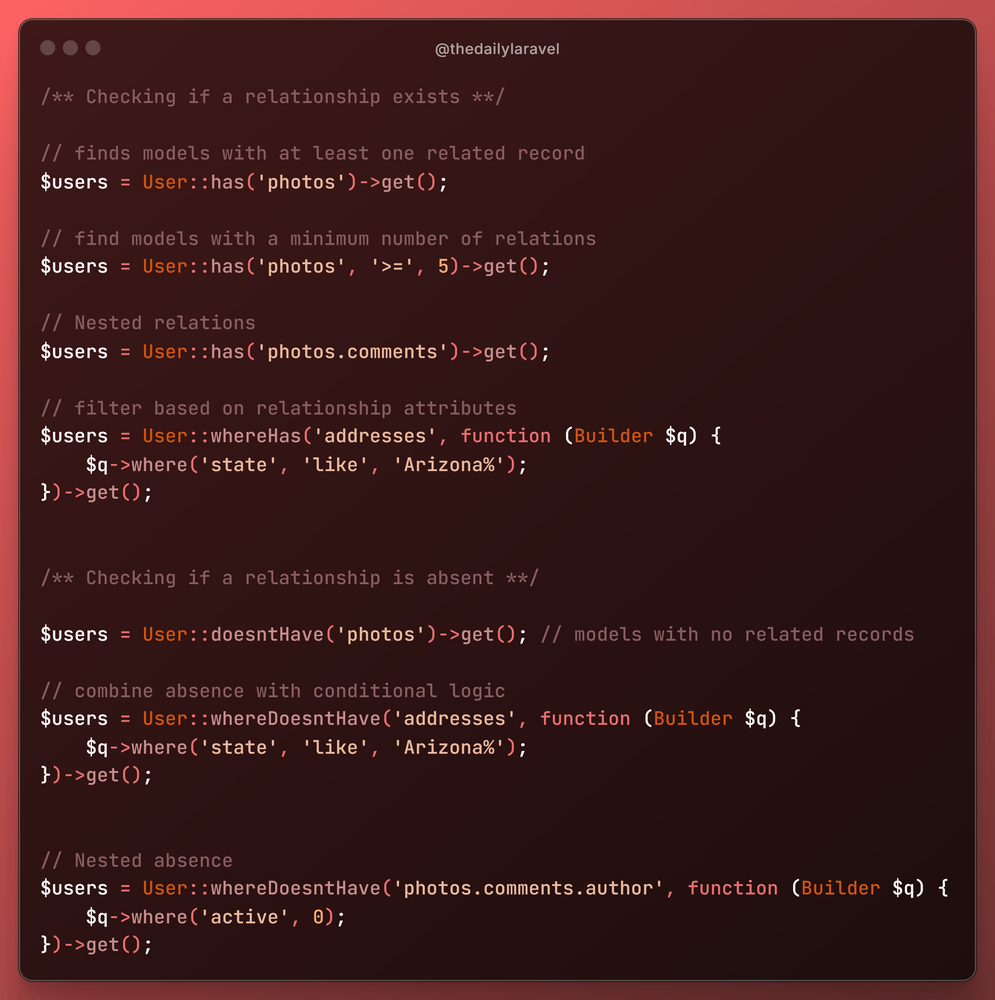
Checking relationship existence (or non-existence) in Laravel Eloquent
These Eloquent methods are efficient and expressive. They let you easily filter by relationship existence with or without further constraint all within the query builder.
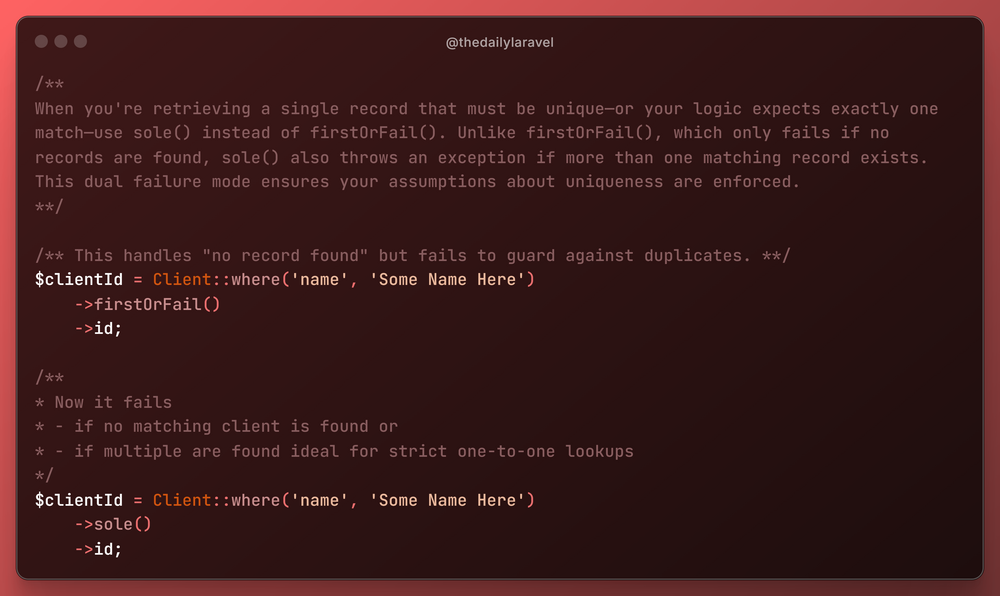
The Right Time to Use the sole() Method in Laravel
- sole(): exactly one match, no more, no less.
- Great for import scripts, commands, or wherever you expect strict uniqueness.
- Useful in tests to assert one-and-only-one condition with meaningful failure messages.
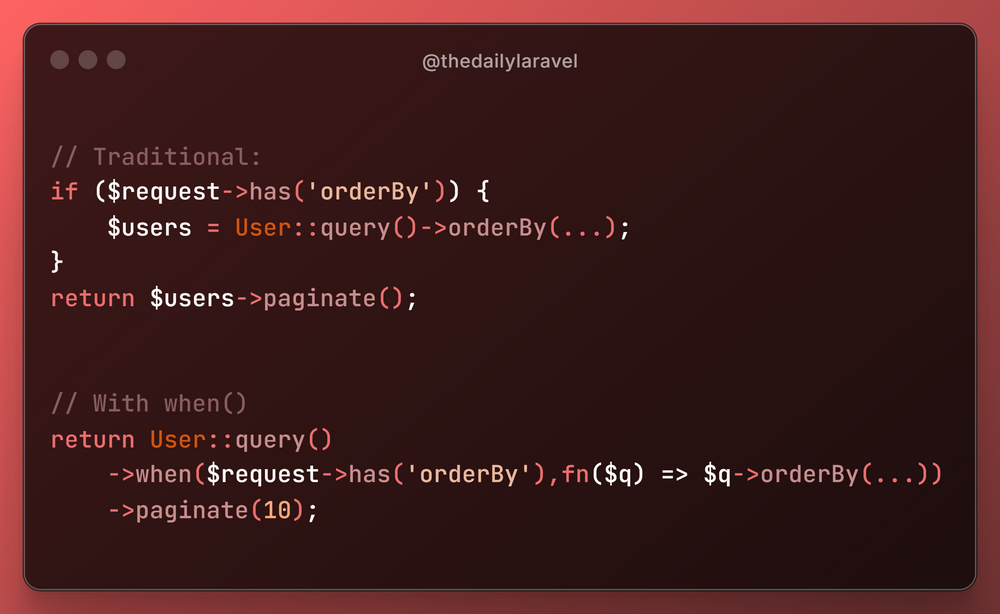
Conditionable trait: when() & unless()
The Conditionable trait, injects two methods into classes (e.g. Query Builder , Request , Fluent, or your own classes):
- when($value, $callback, $default = null): Executes $callback if $value is truthy.
- unless($value, $callback, $default = null): Executes $callback if $value is falsy
Why it’s useful
- Maintains structural clarity: helps build condition-based variations (e.g., queries, request prep, mail notifications) inline
- Highly reusable: not limited to built-in Laravel classes you can include it in any custom class .
- Used across Laravel (Query Builder, Request, Fluent, Collections, etc.) and available for custom usage.
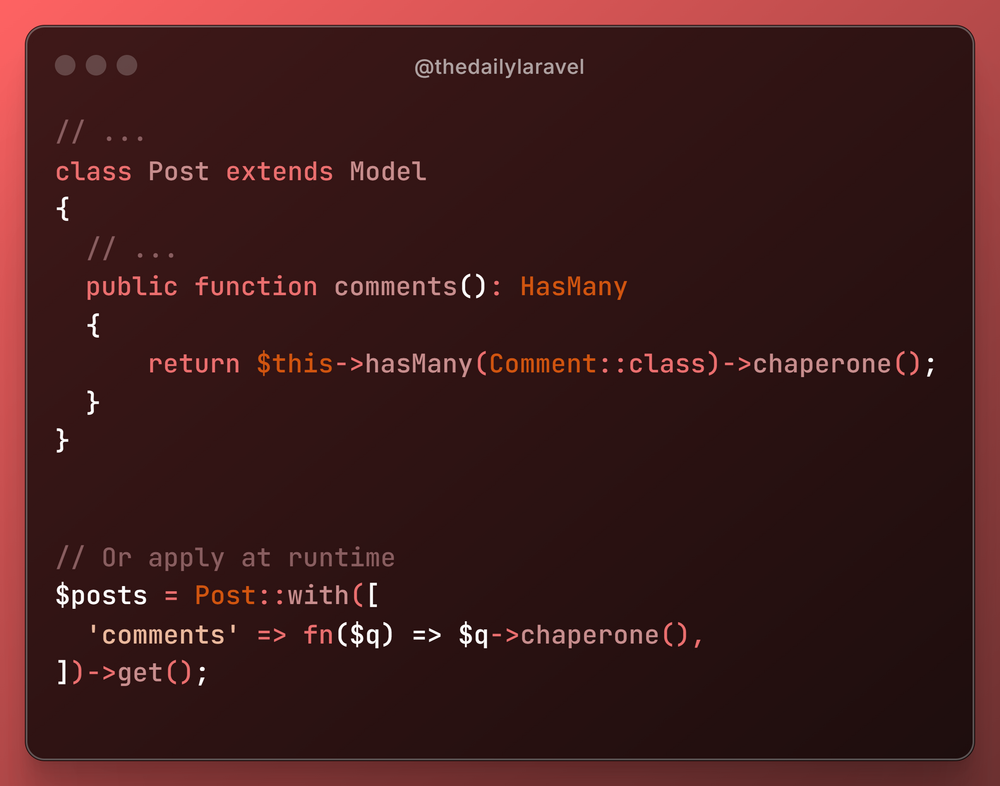
Solving N+1 Queries in Laravel with `chaperone()`
`chaperone()` method in Eloquent relationships especially helpful on inverse or "child-to-parent" relations to automatically hydrate the parent onto each child, eliminating the dreaded N+1 query pattern
This ensures that when we eager load comments, each Comment instance gets its parent Post assigned without extra queries
Why It Matters
Without `chaperone()`, even with eager loading, looping through children and accessing `$comment->post` triggers individual queries for each relationship the classic N+1 pitfall. `chaperone()` bundles the parent relation on the child records in one go, boosting performance and scalability
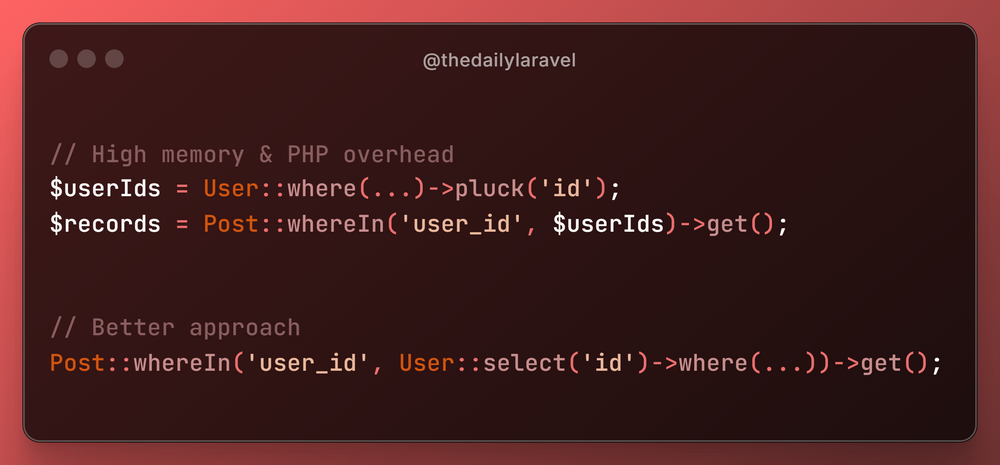
Pass a Query Builder to `whereIn` (or `whereExists`) to Reduce Memory & Queries
Rather than pulling IDs into PHP and passing them as a large array You can push the filtering fully into SQL by passing a query builder directly
Benefits:
- The SQL engine handles filtering in one go.
- No PHP-level array of IDs reduces memory and bandwidth.
- Cleaner code without intermediate variables.
Why it Matters
- If you're doing .pluck('id'), you're pulling all matching IDs into PHP and then pushing them back to SQL inefficient and unnecessarily verbose.
- Piping the subquery directly keeps everything in SQL, which is both faster and cleaner.